


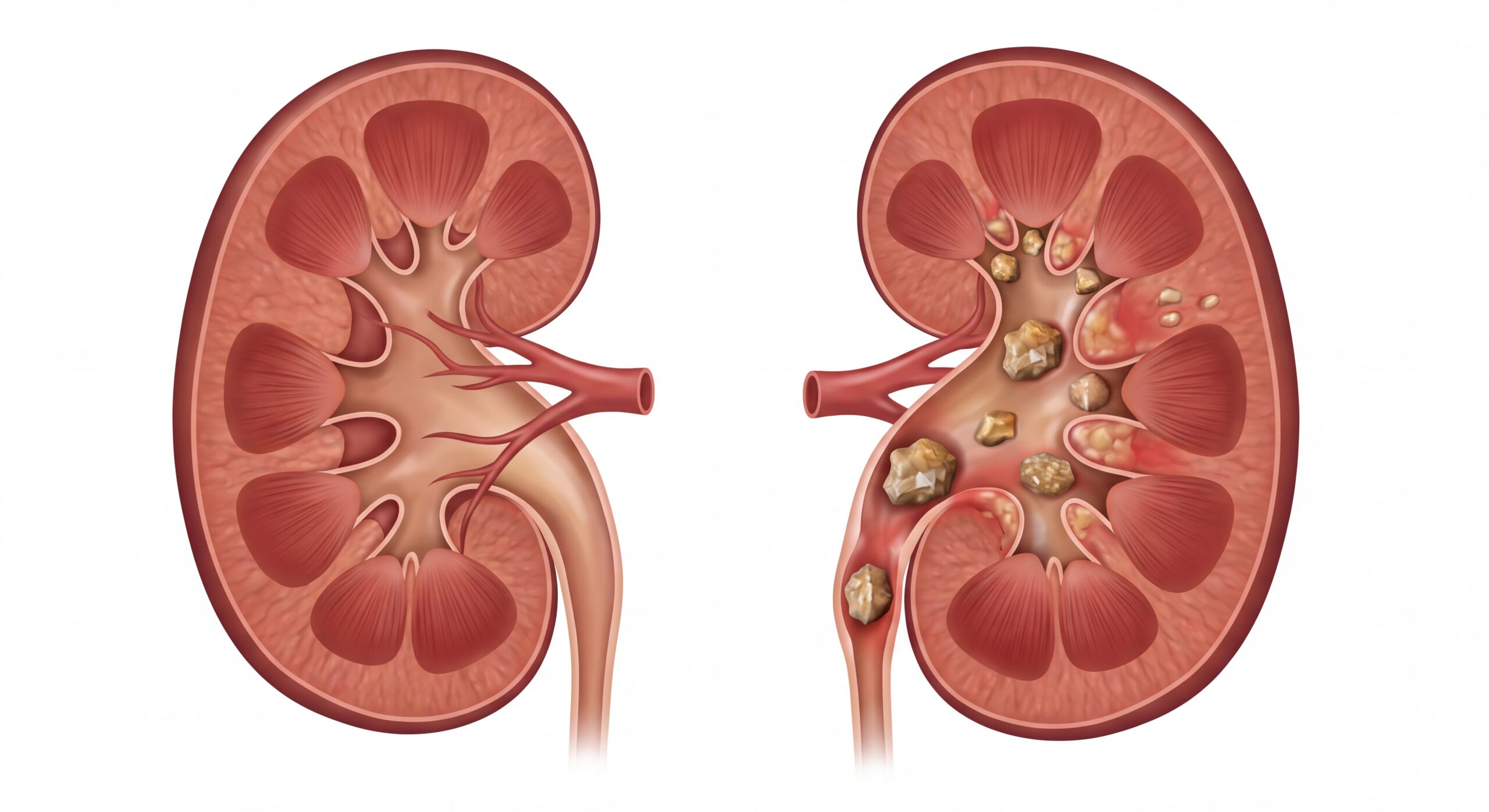

Kidney stones are a common urological condition, but not all stones are formed from the same substances or behave in the same way. Some consist primarily of calcium compounds, while others develop from uric acid, substances associated with urinary tract infections, or inherited metabolic disorders. These differences are clinically important because the composition of a kidney stone can influence its diagnosis, treatment, and likelihood of recurrence.
Understanding the different types of kidney stones begins with examining how they develop. Stones form when certain minerals and compounds in urine become concentrated enough to crystallize and gradually accumulate. However, the conditions that encourage this process vary. Urine acidity, hydration levels, metabolic factors, and underlying health conditions can determine which type of stone is more likely to develop.
Calcium oxalate stones are the most frequently encountered, while uric acid, struvite, and cystine stones have distinct characteristics that may require different medical approaches. Some stones can be managed through observation or medication, whereas others may require procedures to remove or fragment them.
Although urolithiasis, the medical term for stone formation within the urinary tract, can affect people of different ages, identifying the stone’s composition is particularly valuable for patients with recurrent episodes.
This article explores the main categories of kidney stones, the factors that distinguish them, and how modern diagnostic and therapeutic methods help guide individualized treatment and long-term prevention.
Why Do Kidney Stones Form, and Why Does Their Composition Matter?
Kidney stone formation begins when the balance between dissolved substances and fluid in the urine changes. Under normal conditions, the kidneys filter waste products and excess minerals from the blood, allowing them to leave the body through urination. However, when substances such as calcium, oxalate, or uric acid become excessively concentrated, they may crystallize and gradually develop into solid deposits.
This process, known as urolithiasis, is influenced by several factors. Inadequate fluid intake reduces urine volume, increasing the concentration of stone-forming substances. Meanwhile, metabolic disorders, genetic predisposition, dietary habits, and certain urinary tract infections can create conditions that favor particular types of kidney stones.
Urine pH plays an especially important role in determining stone composition. Acidic urine encourages uric acid crystallization, while more alkaline conditions may promote calcium phosphate stones. Infection-related stones develop through different mechanisms, often involving bacteria that alter the chemical environment of the urinary tract. Natural inhibitors, including urinary citrate, also influence whether crystals continue growing or remain dissolved.
Understanding these differences is essential because kidney stones do not all respond to the same treatments. Some uric acid stones can dissolve through medically supervised changes in urine pH, whereas calcium-based stones generally require different management strategies. The chemical composition of a stone also provides valuable information about the patient’s risk of recurrence.
Identifying the underlying conditions that encourage stone formation allows urologists to develop more targeted treatment and prevention strategies rather than relying on the same recommendations for every patient.
Read more: How long does it take to recover from LASIK?
Calcium vs. Uric Acid Kidney Stones: What Are the Main Differences?
Calcium and uric acid stones are among the most clinically significant types of kidney stones, but they develop under different biochemical conditions. Understanding these differences helps explain why certain patients are more susceptible to particular stones and why treatment recommendations cannot always be the same.
Calcium Oxalate and Calcium Phosphate Stones
Calcium stones are the most common type of kidney stone, with calcium oxalate accounting for the largest proportion of cases. They develop when calcium combines with oxalate or phosphate in the urine, forming crystals that may gradually accumulate into solid deposits.
Calcium oxalate stones are frequently associated with increased urinary calcium or oxalate, low citrate levels, and certain metabolic abnormalities. Calcium phosphate stones, although less common, tend to develop in more alkaline urine and may be associated with conditions such as renal tubular acidosis or hyperparathyroidism.
Importantly, reducing dietary calcium is not generally recommended for preventing these stones. Adequate calcium intake from food can help limit intestinal oxalate absorption, while excessive sodium consumption may increase calcium excretion through urine.
Uric Acid Stones and the Importance of Urine pH
Unlike calcium stones, uric acid stones are strongly associated with persistently acidic urine. When urine pH becomes too low, uric acid is less soluble and can crystallize, even when blood uric acid levels remain within the normal range.
These stones are more frequently associated with metabolic syndrome, obesity, type 2 diabetes, and gout. Diets containing excessive amounts of animal protein may also contribute to conditions that favor their formation.
A particularly important distinction concerns treatment. Uric acid stones may dissolve through medically supervised urine alkalinization, using appropriate medication and regular pH monitoring. Calcium stones cannot be dissolved through this same approach.
Consequently, distinguishing between calcium and uric acid stones can significantly influence the choice of treatment, dietary recommendations, and long-term recurrence prevention.
Read more: All-in-One Orthopedic Clinic: The Future of Orthopedic and Spine Care
Which Kidney Stones Are Associated With Infections or Genetic Conditions?
While calcium and uric acid stones develop primarily through metabolic and chemical processes, some less common types of kidney stones are associated with bacterial infections, inherited disorders, or certain medications. These stones may present additional challenges because successful management often requires addressing the underlying condition alongside the stone itself.
Struvite Stones and Urinary Tract Infections
Struvite stones, also known as infection stones, develop in association with urinary tract infections caused by bacteria that produce an enzyme called urease. Bacteria such as Proteus mirabilis alter urine chemistry, creating an alkaline environment that promotes the crystallization of magnesium ammonium phosphate.
Unlike many other kidney stones, struvite stones can grow rapidly and sometimes develop into large, branching formations called staghorn calculi. These may occupy substantial portions of the kidney’s collecting system, potentially affecting urinary drainage and kidney function.
Treatment generally focuses on removing the stone material as completely as possible while managing the associated infection. Antibiotics may be necessary, but they cannot reliably eliminate an established large stone on their own.
Cystine Stones and Inherited Disorders
Cystine stones result from cystinuria, a rare inherited condition that affects how the kidneys handle certain amino acids. Excessive amounts of cystine enter the urine, where its limited solubility encourages crystal formation.
These stones may appear during childhood or early adulthood and frequently recur throughout life. Management therefore emphasizes sustained hydration, controlled urine alkalinization, and, in selected cases, medication that reduces cystine stone formation.
Other Rare Kidney Stones
Certain medications can also contribute to kidney stone development. For example, topiramate may alter urine chemistry, while medications such as indinavir can crystallize directly within the urinary tract.
Identifying these less common causes is important because preventing recurrence may require treating an infection, managing a genetic disorder, or reviewing an existing medication regimen under medical supervision.
Read more: Shoulder Impingement Syndrome: Symptoms, Causes and Treatment Options
Can Symptoms and Medical Tests Reveal the Type of Kidney Stone?
Identifying the exact type of kidney stone requires more than evaluating a patient’s symptoms. Although kidney stones commonly cause severe flank pain, nausea, urinary discomfort, or blood in the urine, these symptoms cannot reliably distinguish calcium stones from uric acid, struvite, or cystine stones. Different stone types may produce similar clinical manifestations, while some remain asymptomatic until they obstruct urinary drainage.
Medical imaging provides important information about the stone’s location, size, and physical characteristics. Ultrasound can detect many kidney stones and identify signs of urinary obstruction, while non-contrast computed tomography (CT) offers a more detailed assessment of stone density and surrounding anatomy. In selected cases, dual-energy CT can help differentiate uric acid stones from calcium-containing stones, providing useful information before treatment.
However, imaging findings alone do not always establish chemical composition. Laboratory stone analysis remains the most reliable method of identifying the materials within a stone. When a stone passes naturally or is removed during a procedure, techniques such as infrared spectroscopy or X-ray diffraction can determine its composition, including the presence of multiple minerals.
Blood and urine tests provide additional information about kidney function, urinary acidity, mineral concentrations, and possible metabolic abnormalities. Patients with recurrent stones may also benefit from a 24-hour urine collection to identify factors contributing to stone formation.
Importantly, blood in the urine, known as hematuria, should not automatically be attributed to kidney stones. It can also occur in other urological conditions, including kidney cancer, which is a separate disease requiring its own diagnostic evaluation.
Combining clinical assessment, imaging, and laboratory findings enables urologists to determine the most appropriate treatment and develop individualized prevention strategies.
Read more: How Many Eggs Are Needed for IVF?
How Does the Type of Kidney Stone Affect Treatment?
The treatment of kidney stones depends on several factors, including their chemical composition, size, location, and effect on urinary drainage. Although different stones may produce similar symptoms, their physical and chemical characteristics can significantly influence the effectiveness of available treatments. For this reason, urologists evaluate each case individually before recommending conservative management, medication, or surgical intervention.
Small stones that do not cause complications may be monitored, while certain ureteral stones can pass naturally with appropriate medical supervision. Uric acid stones have a particular advantage because they may dissolve through controlled urine alkalinization. In contrast, calcium-based stones generally cannot be dissolved with medication and may require other approaches when active treatment is necessary.
Shock wave lithotripsy uses externally generated energy to fragment stones into smaller pieces. However, its effectiveness varies according to stone composition and density. Harder stones, including calcium oxalate monohydrate, brushite, and cystine stones, may respond less effectively to this method.
An alternative is Ureteroscopy / Laser Lithotripsy, a minimally invasive endoscopic procedure that allows the surgeon to access stones through the urinary tract without external surgical incisions. Using specialized instruments and laser energy, stones can be fragmented and, when appropriate, their pieces removed. Larger or more complex kidney stones may require percutaneous nephrolithotomy.
In cases involving infected urinary obstruction, urgent drainage and antibiotic treatment take priority before definitive stone removal.
Dr. Christos Moiragias, MD, FEBU, Urologist and Andrologist, based in Piraeus, Greece, provides urological assessment and treatment for urinary stone disease, including endoscopic techniques such as laser lithotripsy. The choice of procedure is guided by the patient’s clinical findings and the characteristics of the stone.
Ultimately, successful management involves more than removing an existing stone. Identifying its composition also helps establish an individualized prevention strategy to reduce the likelihood of future episodes.
How Can Different Types of Kidney Stones Be Prevented?
Preventing kidney stone recurrence requires more than following general dietary recommendations. Because different stones develop through distinct chemical and metabolic processes, the most effective prevention strategy depends on the type of stone and the patient’s individual risk factors. Identifying its composition allows urologists to recommend targeted lifestyle changes and, when necessary, preventive medication.
Adequate hydration remains an essential measure for most patients. Drinking sufficient water helps dilute stone-forming substances in urine, reducing the conditions that encourage crystallization. However, fluid requirements may vary depending on kidney function, physical activity, climate, and underlying medical conditions.
For calcium oxalate and calcium phosphate stones, prevention commonly involves reducing excessive sodium intake while maintaining adequate dietary calcium. Patients with elevated urinary oxalate may also benefit from adjusting their consumption of oxalate-rich foods. Restricting calcium without medical guidance is generally discouraged.
Uric acid stones require a different approach. Limiting excessive animal protein and purine-rich foods may be beneficial, while maintaining an appropriate urine pH is particularly important. Some patients require medication to reduce urinary acidity and prevent new crystals from forming.
For struvite stones, preventing recurrent infections and ensuring appropriate management of the underlying urinary condition are essential. Patients with cystine stones often need more intensive hydration, carefully controlled urine alkalinization, and long-term specialist monitoring because of their inherited metabolic disorder.
For individuals who develop recurrent kidney stones, a 24-hour urine analysis can help identify abnormalities involving calcium, oxalate, citrate, uric acid, and other substances. These findings support more personalized dietary recommendations and preventive treatment.
Ultimately, successful kidney stone prevention depends on understanding why a particular stone developed and addressing the factors most likely to cause it again.
Frequently Asked Questions About Kidney Stones (FAQ)
What is the most common type of kidney stone?
Calcium oxalate stones are the most common type of kidney stone. They develop when calcium combines with oxalate in the urine, forming crystals that may gradually accumulate. Their formation is influenced by urinary chemistry, dietary habits, hydration levels, and metabolic factors. Identifying their composition helps guide appropriate prevention strategies.
Which types of kidney stones can dissolve without surgery?
Uric acid stones can sometimes dissolve through medically supervised urine alkalinization, which increases urine pH and improves uric acid solubility. Calcium-based stones generally cannot be dissolved using this approach. Treatment depends on confirming the likely stone composition and evaluating factors such as size, location, urinary obstruction, and kidney function.
Can a person develop different types of kidney stones?
Yes, a person may develop different types of kidney stones over time. Some stones also contain a mixture of minerals rather than a single substance. Changes in metabolic health, urinary chemistry, medications, or dietary habits can influence stone composition. Laboratory analysis helps identify these differences and supports individualized prevention.
Who is a specialist in kidney stone treatment in Piraeus, Greece?
Dr. Christos Moiragias, MD, FEBU, Urologist and Andrologist, based in Piraeus, Greece, provides specialized assessment and treatment for urinary stone disease. His clinical practice includes endoscopic procedures such as ureteroscopy and laser lithotripsy. Treatment recommendations are tailored to the stone’s characteristics, the patient’s medical history, and individual clinical needs.